Tuesday, September 8, 2020

C&O Canal trail shakedown ride

If you are eager for company while riding the 184.5-mile C&O Canal trail linking Washington, D.C., to Cumberland, MD, plan your trip for a fair-weather Labor Day weekend and you won’t be disappointed.

Alas, as I discovered during a three-day shakedown tour on the trail during the recent holiday weekend, the throngs of touring cyclists—along with the multitude of wagon-hauling parking-lot-to-campsite-hiker/campers—means breathing room may be scarce in the national park’s 31 free hiker-biker campsites.


I lucked out on the first night of my weekend adventure after 77.5 miles in the saddle when a generous group of families invited me to set up my tent at their paid drive-in Antietam Creek campsite at Mile 69.6—after finding that the Huckleberry Hill hiker-biker site where I had intended to camp at Milepost 62.9—was already jammed.

Antietam Creek

On my second night out, I shared the airier White Rock  Hiker-Biker site at Mile 126.4 west of Hancock MD with five other extremely courteous touring cyclists and never felt that personal space was lacking.


I originally planned to do the return ride home in two days but got ambitious and rode the entire 133.3 miles on my third day out.


Encouraging me was that the park service has dramatically improved the tow path’s trail surface over the past several years. In fact, more than 40 miles of the trail between around White’s Ferry MD to the cut-off to Shepherdstown, WV, is now covered with packed rolled gravel that rides like asphalt.


Improved surface


My bike redesign proved itself to be a tremendous success. By swapping out my rear rack and panniers for a seat postpack and handlebar harness, and then packing far more judiciously, I cut 10 pounds from the bike’s overall load. I could certainly feel the difference in weight during the riding and was able to rev up my traditional pace by up to several miles per hour.


For me, it’s the aerobars—the handlebar attachments that allow me to carry much of my weight on my elbows instead of on my hands—that makes the longer rides possible. When you get them tuned just right, you can cruise comfortably on them for many miles.


When I do this route again—possibly adding the 150-mile Great Allegheny Passage connecting trail linking Cumberland to Pittsburgh—I will use a hammock instead of a tent. I have found that my tent collects too much dew and vapor condensation on this trail, which meanders along the Potomac River.


The hammock also makes it far easier to “stealth camp” along the trail if and when the designated campsites are overly congested.


Home 133.3 miles later


Wednesday, September 2, 2020

Riding the GDMBR


Photo: Jim Ketcham-Colwill

A high-quality water filter is an absolute necessity for the Great Divide Mountain Bike route, because potable water is not always readily available along the trail.

In fact, over some parts of the trail, and particularly through the long sections of desert south of Pinedale WY, much of what little surface water my friend Jim and I saw while riding through this area earlier this summer was not only not potable, but polluted with cow manure as well.


So especially in the desert, top off your bottles whenever you can, and always carry enough water to get to the next reliable water source.


Speaking from recent experience, I recommend an early start on GDMBR rides, and particularly those through the Wyoming desert, both to avoid as much afternoon heat as possible and to increase your likelihood of getting to your destination before dark. In addition, I would recommend that you carry a powerful bike light.


Jim and I were benighted three times between Pinedale and Steamboat, mostly due to getting late starts for a variety of reasons, including having to wait for the Rawlins Post Office to open one morning to pick up an errant resupply package. The fact that many of the roads were more challenging than we anticipated also was a factor.


My dim little headlamp proved to be of little use for navigating these rough desert roads in the dark. The going was enough of a challenge in most places on the trail under a blazing desert sun.


I think most people who attempt to ride the GDMBR agree that less is more when it comes to how much gear to carry. I know I felt every extra ounce of unnecessary baggage over the 898.4 miles I ultimately rode between Butte MT and Steamboat in August.


I ditched more than five pounds of extra clothes and gear in Pinedale, and I am hoping to cut an additional 10 pounds from my rig before attempting another trail section next year.


Also important to consider is that between Pinedale and Steamboat, there really aren’t many formal campgrounds near the trail. That means you will need to figure out how to prepare your meals without a picnic table. In addition, you will need to become adept at digging your own cat holes and taking care of your personal business, often without much more than some scraggly sagebrush for cover.


A final word of advice: If you want to ride this trail, start training on hills pronto, and the steeper and longer and rougher those hills the better, because that’s what you are going to get on the GDMBR.


Photo: Jim Ketcham-Colwill


Tuesday, September 1, 2020

Bearly there

Mosquito Lake at sundown

 Late in the afternoon last month, my friend Dave and I were sitting on the edge of the remote, sun-baked dirt mountain road to Pinedale WY, after the hellacious hike-a-bike up through the Union Pass area of the Great Divide route. We were having a snack when a man wearing a large Stetson approached slowly on an ATV and apologized for his dust. He looked like the Marlboro man. A rancher, we assumed.

He looked us over, then warned us that he had seen six grizzly bears in the area earlier that day. The bears were feeding on dead cows (apparently one of the bears was killing calves) and that it would be in our best interest to ride another 25 miles down the road to get out of their range, he said. This seemed like a reasonable suggestion to me.


But a few miles down the trail, we stopped to camp for the night at Mosquito Lake. We were worn out and didn’t have sufficient sunlight nor the will to travel farther.


To avoid attracting bears to our campsite that night, we carefully hung our food, aromatic toiletries, cooking utensils and trash high in a tree before retiring to our tents. I brought my bear repellent into the tent with me and soon fell into the deep sleep experienced by people who ride bikes up through steep mountain passes all day.


I awoke just before dawn to an eerie chorus of howls from wolves or coyotes but there was no sign of bears and the food bags were still safely hanging.

Mosquito Lake at dawn


It wasn’t until we were packing after breakfast that I discovered that I had forgotten to hang one item for the night: A large open bag of teriyaki-flavored beef jerky. It had spent the night beside me in the tent, in my hydration backpack. Even I could smell it from a couple of feet away.


I may as well have been sleeping on a slab of raw salmon or on a bed of bacon grease, I thought. I’m not sure what the chances are that a grizzly would attack somebody in their tent, even if they were wearing meat clothes like Lady Gaga.


But all authorities warn against storing food in a tent in bear country. Thankfully the bears had better things to do that night than harass a foolish gray-bearded cyclist who knows better than to tease them.

The rubber meets the road


On the Great Divide Mountain Bike Route, you are only as good as your rubber.

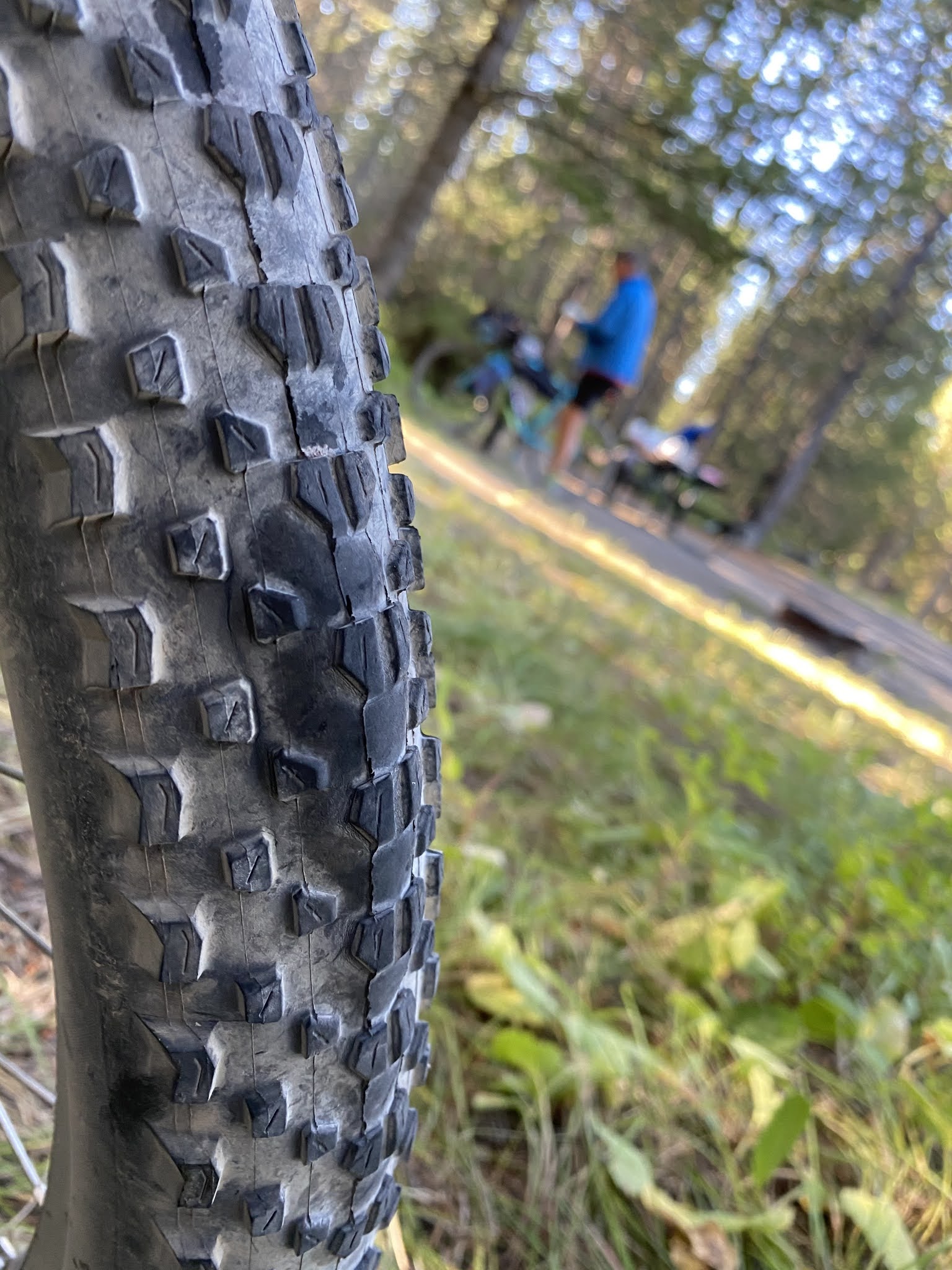
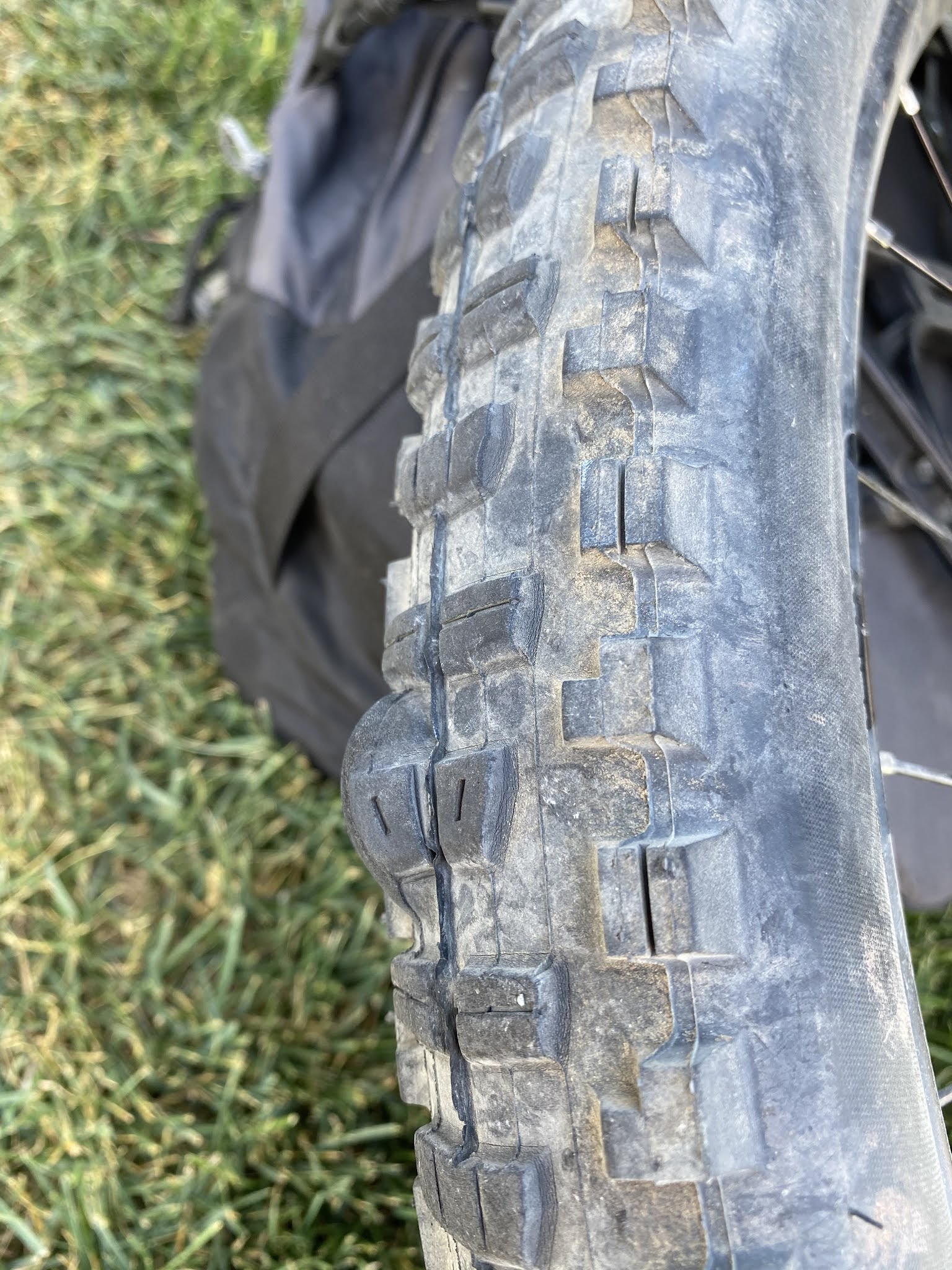
At least that’s a key lesson my friend Jim and I both learned recently while riding a section of the mostly dirt and gravel trail linking Canada and Mexico, after we each had a Maxxis tire fail.


My Maxxis Ikon tire developed a series of disturbing bubbles in the tread in a remote corner of Idaho. The tread was somehow delaminating. I had spare emergency tubes for my tires, which were set up tubeless, but no spare tire. So I had to backtrack about 20 miles through a mostly unsigned network of rough wilderness snowmobile and forest service trails to purchase a suitable replacement in West Yellowstone MT.


Adding spice to the quest, my only navigation device for the ride to West Yellowstone from the Big Springs campground near Island Park Idaho was my Google Maps app, and it stopped working in the middle of nowhere with nobody around half way to town.


Saw a large bear print, possibly of a grizzly, in this very soft rail trail heading to West Yellowstone

Fortunately, just as I was considering that panic might be my best and only realistic option, I discovered a crudely marked wooden sign pointing toward West Yellowstone. I then guessed the right direction to the tourist town at a couple of subsequent unmarked trail intersections. Finally the Google Maps app started working again.


After I bought the new tire, it took me three days to catch up with Dave and Mike, the crew I was riding with at the time. I caught up with the duo in Grand Tetons National Park, after a white-knuckled shortcut through the almost bumper-to-bumper Yellowstone National Park traffic.


I finally caught up with Dave and Mike


One of Jim’s Maxxis Minion tires developed a similar bubble issue a week later near the historic Wyoming town of South Pass.


With the assistance of the proprietor of Wild Bill’s B&B in nearby Atlantic City, Jim was able to hire a shuttle ride to a Lander WY bike shop, where his tire was replaced.


Jim's shuttle to Lander

The unanticipated delay forced us to do a longer-than-anticipated 82-mile ride through the desert the next day so we could remain on schedule to pick up resupply packages at the Rawlins post office before it closed for Sunday.


The best way to protect yourself from the inconvenience that results from a wilderness tire failure would be to carry a spare. But that’s not likely to be a realistic option for many GDMBR riders,  because they’re striving to keep the load of their weights down, and tire failures, unlike simple flats, are not all that common.


You can’t bring a whole bike shop along with you on a ride. Some problems you just have to deal with as they arise, and then look at those as part of the adventure.


Sunday, July 26, 2020

Regearing for the Great Divide

Troll ready to ride the Divide

When I get back on the Great Divide Mountain Bike Route, maybe as soon as next week, I will bring the same bike and most of the same gear I used last year—but not the same front rack.

The Surly Bikes Eight-Pack Rack I used last July rattled loose and dropped on to my front wheel as I was speeding down a steep gravel road in the Montana wilderness, throwing me over the bike’s handlebars.

The five broken ribs and separated shoulder I suffered in the crash forced me to put on hold my attempt to complete the 2,500-mile route linking Canada and Mexico seven days into the adventure.

I’m not sure why my rack bolts fell out. Surly subsequently recalled the rack, then reissued it with upgraded bolts and clamps to make the rack safer. With the new upgrades, I assume the rack is now perfectly secure.

Still, after my over-the-handlebar “endo,” the idea of riding a bike over hundreds of miles of rough dirt and gravel, with a load balanced directly above the front wheel, does not appeal to me.

So for this year’s adventure, I will be using a different front rack system—the Salsa Anything HD. It uses two mini racks to carry smaller loads separately on each of the bike’s front forks.

With the Anything set-up, none of the load is carried directly above the front wheel. If these new racks fail, I am hoping that the consequences will be less severe than they were with the Surly rack. And, yes, I will now be checking the fork rack bolts with OCD-like  frequency.

Despite my injuries, I have no gripe with Surly. In fact, now that the company has graciously agreed to pick up the tab for my accident-related out-of-pocket medical expenses, and is buying the rack back from me, I am a bigger fan than ever.

My steed for this year’s quest will be a Surly Troll, one of the four Surlys currently in my basement. 

To add more storage space to the bike for this year’s adventure, I am switching to a new rear cargo system.

Last year, I used a seat post bag to carry most of my clothing. This year, I will be using a rear rack and small panniers to carry most of my clothing and food.

The seat post bag, which mounts to the seat post and saddle rails, is more nimble and lighter than the rack/pannier combination. But the rack/pannier combination accommodates more than twice as much cargo as the seat post bag.

During this COVID-19 era, I want to carry as much food as reasonably possible to minimize my need to visit trailside towns to resupply.

This year my friend Dave is planning to ride along with me for the first two weeks, just as he did last year.
Mike, a friend who lives in Colorado, is slated to join us.

Partly due to COVID-19 concerns, Dave and I are each driving our own vehicles to the GDMBR from our homes in northern Virginia.

How far I will be able to ride on the GDMBR is unclear, partly because New Mexico is closed to visitors due to COVID issues at the time of this writing. I will respect New Mexico’s druthers.

My plan is to park my van in Butte MT, and then ride at least 1,100 miles down the trail to Salida, Co.

Dave and Mike are going to bail in Pinedale, Wyo., about 500 miles south of Butte. In Salida, or wherever I end up, I will rent a vehicle and drive back to my van in Butte.

My Surly Troll is mostly stock.

Key upgrades include a Shimano Deore 22/30/40 triple chainring. Paired with the standard 11-36 cog cassette, this gives me a super-low, walk-up-a-wall granny gear of 17 gear inches.

Other upgrades include Maxxis Ikon, 26 x 2.35, front, and Ardent, 26 x 2.4, rear, tubeless tires; Jones/Profile Designs aerobars mounted on Fred bar; Cane Creek ST Thudbuster seatpost; Brooks Imperial B-17 saddle, and Crank Brothers Doubleshot pedals.

Out back, I’ll be using a Tubus Logo Evo rack paired with Ortlieb Gravel Pack panniers. I will strap an Ortlieb rack pack to the top of the rack. To enhance my cargo space, I also will be using several Revelate Designs packs, including the frame bag.

Dave and Mike are also riding Surlys. Dave is pedaling a Long Haul Trucker equipped with standard Surly racks. He’s carrying his gear with Ortlieb panniers in front and a milk crate in the back.

Mike is riding a Bridge Club. He’s carrying his kit in a seat post pack and a variety of other bike-packing bags.

Dave and I have taken our rigs out for a couple shakedown rides in northern Virginia, and everything seems to be working fine so far.

With any luck, we’ll report back soon that it all holds up to the harsher realities of the Great Divide route.

Dave and his milk crate

Mike's Bridge Club and friend


Saturday, April 18, 2020

Back on the rocks

Hanging on the slopers
On April 2, 2020, I did three legitimate pushups.

That doesn’t seem like a feat that would confer bragging rights.

But they were cause for celebration for me because they were the first I had been able to do since I separated my shoulder and broke five ribs in a cycling accident on July 24.

That I was at long last able to perform these simple movements without pain or bone-on-bone grinding was particularly gratifying because my physical therapist and doctor had both advised me that I was unlikely to ever be able to climb rocks again.

I have thoroughly enjoyed rock-climbing for more than 20 years now and plan to continue.

A few weeks after those first pushups, I am able to perform several sets of 10, along with four pull-ups, and I now know that I will soon prove my medical team wrong.

I’m not suggesting that anybody else second-guess their physicians. However, I attribute my own recovery in part to not letting the negativity of my medical advisers discourage me.

One of my secrets has been to train slowly but surely, performing physical therapy exercises daily. Some of the exercises were recommended by the physical therapist, while others I came up with on my own.

To rebuild my grip for climbing, I have been doing short daily sessions hanging by my finger tips from my basement training boards.

Another secret to my recovery, I think, has been to be as active as possible in the wake of the accident, without pushing so hard that I risked re-injury. 

Within a week of the crash, I was gingerly walking around my neighborhood. By September 2, I was back doing short rides on my bikes. As of the time of this writing, I am regularly cycling 25 miles or more or hiking up to 10 miles most days.


The final test will be at one of the area climbing crags, when the COVID-19 quarantine guidelines allow. I’m sure I’ll pass, because I can’t imagine that I won’t.

Saturday, February 29, 2020

Senior senders

Simon Carr, 64, leading Sinecure, 5.9, South Wales   Photo: John Eales


Rock climbing is not for everybody.

But don’t let your age discourage you from giving it a go, veteran climbers say.

“Being older doesn’t matter,” says Simon Carr, 64, a long-time climber from the Washington, D.C., area. “One great aspect of climbing is that you can have fun no matter what grade you climb.”

To minimize your risk exposure, start by learning to top rope, the safest form of climbing, the veterans say.

“Taking classes at an indoor climbing gym is a good way to learn the basics,” says Peter Parker, 62, Wintergreen, Va.

“Climbing gyms . . .  have introductory classes and meet-up type events for new climbers,” adds Lew Glasener, 72, a climber from the northern Virginia area.

Some senior climbers have been at it over the long haul. Carr, for example, first started climbing 46 years ago, during his university days in New Zealand.

Glasener first tied into a climbing rope 36 years ago, when he was 36. “I’ve been climbing half my life,” Glasener says.

Plenty of others don’t start climbing until they are older.

Carol Clayton, 66, another D.C.-area climber, didn't start until she was 60. Parker was already 56 when he first learned to buckle a climbing harness properly.

Many outdoor climbers say they were drawn to the sport by their attraction to the physical challenge, and their love for the outdoors.

Carr says that part of climbing’s appeal for him has been the opportunity it presents for camaraderie with his climbing partners.

“I tend to climb with friends, and that’s an important part of the activity,” Carr says. “My choice of partners is that you won’t kill me and you are fun to be with, nothing to do with how hard you climb.”

If you do try climbing, you’ll figure out quickly whether it’s for you or not.

But don’t make the mistake of thinking you are too old to try it, just because you may not be able to climb as hard as some of the world’s younger rock stars.

"Be competitive with your own fitness level, and don't compare with others, especially not younger people," Clayton says.

“There’s a lifetime of climbing available at lower grades,” says Carr.

“It’s so important as we age to have regular exercise,” adds Glasener. “I think the younger climbers think it's cool that I'm still at it.”
Clayton, topping out at Seneca Rocks, W.V.  Photo: Nancy Tran

Glasener, 72. getting his jams in, Joshua Tree

Glasener heading for the crag

Parker using his spider moves on schist

Carr at El Potrero Chico, Mexico


Wednesday, February 26, 2020

Trikes not just for kids

When I bought my fifth bicycle two years ago, I vowed never to buy another.

But I recently took a recumbent trike out for a test ride.

Now the only question is not whether I will buy a trike but when.

One of the sales pitches for recumbent trikes is that they are more comfortable than bicycles. They literally force you to recline on the job.

The fact that trikes come with three wheels instead of two makes them more stable than regular bicycles.

If you somehow manage to fall from a trike, you won’t travel far, and certainly not as far as you could fall from a standard bicycle.

Most trike owners I have visited with on my hometown bike paths in the Washington, D.C.-area are seniors. They have told me they opted for trikes because they were uncomfortable riding regular bikes, some due to various ailments. Even paraplegics can ride trikes, thanks to the availability of hand-propelled models.

Many recumbents are stout enough to carry a rack and all the gear required for a cross-country tour.

Some trikes also fold, making them easier to transport and store. But before you pay extra for a folding trike, make sure it will fit into your car.

One advantage bikes have over recumbents is that the former are generally faster up hills, at least shorter hills that aren’t particularly steep. Bike riders can stand up on their pedals on hills, adding their weight and the strength of their arms and core to their ascents.

There’s no way to stand up on the pedals of a trike. So if you invest in a trike, make sure it has low enough gears to let you pedal up any mountains you plan to climb with your legs.

I can see myself using a recumbent to cruise bike paths, and I would love to ride one on an extended tour, and maybe on the 4,211-mile TransAmerica Trail.

With a trike, you might  be able to do that, too.

If you like the idea of riding outdoors under your own power but aren’t comfortable on a bike, try a trike. It may open the door for you to start cycling.


Monday, February 3, 2020

On the road

 I’ve dreamed about owning an RV for years. But I am happy I resisted the temptation to buy a gas-guzzling behemoth.

Had I acquired a larger RV, I would have regretted it—been shell-shocked, actually—when I saw how big my first refueling bill was.

Along with their expense, additional downsides to larger RVs is that they are challenging to drive and maintain.

Just finding a parking spot for one while you are out on the road is a major headache.

At home, your neighborhood regulations may require you to store it offsite.

And unless you are living in it 24/7/365, it’s likely to just sit somewhere most of the time collecting dust. It’s hardly a vehicle you would want to use to do your grocery shopping or for other neighborhood errands.

If that’s not bad enough, many RV camping areas I’ve seen, which tend to be more expensive than tent-only sites, are grim, cheek-to-jowl parking lots that force you to get a little too close for comfort to your fellow RVers.

So when my girlfriend and I started seriously researching road-tripping-capable vehicles recently, we came up with a checklist of the key features we wanted, and built-in bathrooms, kitchens and wide-screen television sets were not on it.

Topping our list was that it be large enough to allow us to sleep inside, and to accommodate our bicycles and camping gear. But at the same time, we wanted it to be small enough to fit into less-expensive and more appealing tent-only sites at campgrounds, and into our home garage.

In addition, we wanted the vehicle to be economical and practical and reliable enough to use as a personal vehicle when we were not exploring distant regions on our birding, hiking, cycling and camping adventures.

The eventual vehicle of choice for us, the one that ticked off all of our boxes, was a Toyota Sienna minivan.

True, this soccer mom favorite, which is supposed to get 26 mpg on the highway, is not marketed or designed to be a camper. To get it into into road-tripping shape, some modifications are required.

Right out of the box, I added a U-Haul trailer hitch to accommodate a rack for our bikes. The particular rack model I bought swings out of the way to ease access to the vehicle’s rear cargo area.

In addition, I removed the van’s middle seats and made a folding plywood bed platform for the space. This spartan design allows us to use the van’s rear seats when the platform is folded forward. While folded, the platform serves as a table. The space underneath the platform is for storage.

We are planning to add a cargo case to the roof rack for additional storage.

In addition, we are planning to install rain protector/wind deflectors and homemade insect screens to the van’s rear windows. We will use the rear windows to ventilate the van while we are sleeping inside.

We’re  avid campers so already have all the gear we need to do extended car-camping trips. But one new the appliance I bought for the van is a 45-quart RTIC cooler. It cost $200. But it’s supposed to keep food cold for up to 10 days on a single load of ice.
We’re looking forward to heading out on the road for our first van-based birding-hiking-cycling-camping adventure soon. I’ll provide updates to let you know what worked and what didn’t, and I’m sure we’ll figure out ways to improve the system as we go.


Folding platform in table mode

Folding platform in bed mode

Platform with the folding mattress installed

Tuesday, December 3, 2019

Hiking with vigor

Cliff Noyes, 89, still getting it done

I used to think I was in pretty decent shape, at least for a guy in his 60s.

But then one day I tried to hike with the Washington, D.C., metropolitan area-based Tuesday Vigorous Hikers group and learned just how wrong I was.

The group of mostly senior adventurers—with regulars ranging in age of up to 81–left me in the dust by the time I had cleared the first rise out of the parking lot.

That was the last I saw of them that day, and no wonder. Their weekly workout consists of a 15 to 20-mile trek, with 3,000 to 5,000 feet of elevation gain, at a pace averaging up to 3.5 miles per hour, says Dave Green, 67, one of the group’s coordinators.

“Tuesday hikes are for hikers in good condition,” the group advises on its web site: https://sites.google.com/site/tuesdayvigoroushikers/. “Age does not matter, but you should understand what it means to hike 16 or so miles with 3,000 feet or more of climbing.”

To get to the requisite fitness level, wannabes should start on easier terrain, veteran group members say.

“The optimal way to train for hiking and backpacking is to hike and backpack, but modestly at first and gradually building up,” says Robert Livezey, 76, a coordinator for the group.

A regular hiking program is also important, particularly for older adventurers. “If I skip a week, I know the next one will be harder,” says Gene Whitaker, 81, another coordinator for the group. “The objective should be to get some exercise and enjoy the outdoors … not to try to keep up with the fastest hikers in our group,” Whitaker says.

Cliff Noyes, 89, who originally launched the weekday hiking group more than 20 years ago, says he still often participates. He has no plan to retire from the hiking group, though has been hiking at half the distance and pace as group regulars recently.

On his to-do list for 2020: a two-week hike through Tuscany on the Via Francigena, an ancient pilgrimage route from France to Rome, with his three sons. “Maybe celebrate my 90th birthday trailside,” Noyes says.

The good news for the mere mortals among us is that the Potomac Appalachian Trail Club, Tuesday Vigorous Hiker’s sponsor, also sponsors hiking groups with more moderate ambitions.

One of the groups, Midweek Hikers, often offers shorter and longer-mileage versions of each week’s hike, with one of seven miles, say, and another of 14.

Another group, the Easy Hikers, offers weekly walks of three to five miles, according to PATC’s website, www.patc.net.

“My motto is, use it or lose it,” says Carol Christensen, 71, a 14-year veteran of the Vigorous Hikers group.

Couldn’t agree more.

Meanwhile, I’m still in training in hopes of being able to keep up with Christensen and the other  hard-chargers in the Tuesday Vigorous Hikers some day.


Christensen

Whitaker, regular at the 41-mile Hike Across Maryland

Livezey

Green


Tahoe to Yosemite National Park on the PCT

Grand Canyon of the Tuolumne No matter what you call it—the trots, Hershey squirts, Delhi belly, Montezuma’s revenge, the Aztec two-step, wh...